As always... back to the basics:
What is oliguria?
Low urine output (UOP)
What is "normal" adult UOP?
About 30cc/hr
How might you write a post op floor order for this?
"call house officer if 2 hour UOP is < 60cc"
What are the possible causes?
Think pre renal/renal/post renal causes
What is the most common cause?
Pre renal!
False Starts, Stumbles, and Spectacular Finishes Encountered on the PA Path...
Showing posts with label critical care. Show all posts
7.11.2013
5.20.2013
Atrial Fibrillation
AFib, The Basics
Characteristics
- irregularly iregular
- irregular RR intervals
- not a P wave in front of every QRS
- atrial rate = 400-600bpm, ventricular rate = 80-160bpm
P = pulmonary (COPD, PE)/pheo/pericarditis
I = ischemic heart dz +/- HTN
R = rheumatic heart dz
A= anemia/atrial myxoma
T = throtoxicosis
E = ethanol ("holiday heart)/cocaine
S = sepsis (post-operative)
Signs/Symptoms
- fatigue (most common)
- tachypnea
- palpitations
- lightheaded
Work Up
(Test yourself... why would you order each of these? what are you looking for?) - answers below
- EKG
- ECHO
- TSH (?)
- Baseline coags
- EKG = narrow complex QRS (<120msec), variable RR, irregular or absent P waves
- ECHO = maybe thrombi, maybe dilated L atrium
- TSH (?) = hyperthyroidism can cause AF
- Baseline coags = getting baseline prior to starting anticoagulation
Of note: if you are looking for THROMBI..."normal" ECHOs (transthoracic) has low sensitivity - transesophageal ECHOs allow for better visualization of L atrial appendage (location where most thrombi form)
source: First Aid for the Wards by Le, Bhushan, Skapik
pic source: http://www.saintvincenthealth.com/Services/Heart/Heart-Resource-Library/Atrial-Fibrillation/default.aspx
4.15.2013
Diabetes Insipidus, Part 1
What is it?
- The inability to conserve H20 and maintain optimum free H20 levels
- Pts urinate large amounts of diluted fluid, regardless of the body's hydration state
- Sx: extreme thirst (can even wake pts up at night and drink up to 20L per day!), dry skin, constipation
![]() |
| Click to enlarge |
Upcoming...
Part 2: Diagnosing DI
Part 3: Treatment for Central DI and Nephrogenic DI
Source:
Makaryus/Mcfarlane. DI: diagnosis and treatement of a complex disease Cleveland Clinic Journal of Medicine Jan 2006 Vol 73:1
3.11.2013
Placing External Ventricular Drains
What is an EVD?
A temporary system that allows drainage of CSF from the ventricles to an external closed system.
Caring for a patient undergoing EVD placement Great clinical guideline series by the American Association of Neuroscience Nurses
Preventing Infections When Placing EVDs (video)
Potential placement sites:
| Paine's Point |
| Fraizer's Point |
| Kocher's Point |
If you are having trouble uploading the video, here is the link: http://www.youtube.com/watch?v=x49rY0tZpVI
Pic source: http://www.brain-surgery.us/Drain_Placement.html#kocher
2.01.2013
Repleting K+
Electrolyte imbalances are something that you see a lot on your rotations - especially in internal medicine, emergency medicine, and surgery.
When thinking about repleting a potassium deficiency consider the following:
*This is not meant to substitute for clinical judgement, just suggestions to think about when treating K+ deficiencies in your patients.
Source:
http://www.eric.vcu.edu/home/curriculum/print/Intern_Ward_Survival_Guide_2009.pdf
http://www.surgicalcriticalcare.net/Guidelines/electrolyte_replacement.pdf
photo: http://mattrosenart.deviantart.com/art/Potassium-195578504
When thinking about repleting a potassium deficiency consider the following:
- Goal is of K is greater than 4 in any pt with active cardiac problems
- If your pt has nl renal function: 10mEq of KCl (IV or PO) will increase serum K by about 0.1mEq/L (so if your pt is at 3.6, about 40 mEq of KCl should help correct your patient)
- Don't replete if patient is on dialysis (consult the dialysis team)
- f your pt has compromised renal function: divide the mEq of normal repletion by the pt's Cr (example: pt has Cr of 3, then you use 1/3 of the nl repletion amount - so instead of 9mEq, you'd use 3mEq)
- PO can cause nausea
- IV can be painful
- Typical combos: 10mEq/100cc or 10mEq/50cc (peripheral IV) and 20mEq/50cc (central line)
- Be careful when repleting its with renal insufficiency or in pts with high risk of tumor lysis
*This is not meant to substitute for clinical judgement, just suggestions to think about when treating K+ deficiencies in your patients.
Source:
http://www.eric.vcu.edu/home/curriculum/print/Intern_Ward_Survival_Guide_2009.pdf
http://www.surgicalcriticalcare.net/Guidelines/electrolyte_replacement.pdf
photo: http://mattrosenart.deviantart.com/art/Potassium-195578504
9.17.2012
Surgical Tubes & Drains
Tubes and Drains. Most of the time you don't go over these in PA school. People just keep referring to "JP drains" and "NG tubes" - but if you've never worked in a hospital - you probably have no idea what these are. I will go over some of the more common tubes and drains. If you see one on a rotation and aren't sure what it is or what it does - ask!
Jackson-Pratt (JP) drain:
Blake drain:
Penrose drain:
Nasogastric Tube (NG Tube):
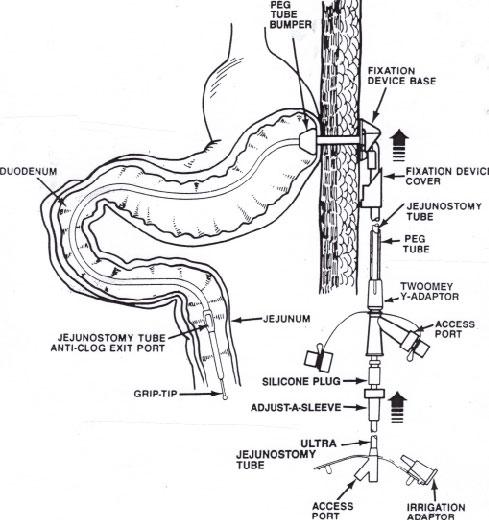
Jejunostomy tube (J-Tube):
GJ Tube/Moss tube:
T-Tube
Source: First Aid for the Medical Student
Jackson-Pratt (JP) drain:
- used to drain surgical wounds and keep bacteria/blood from building up
- usually attached to suction bulb
- if you are asked to "strip" these tubes - it means you need to pull along the length of the clear tube filled with blood [this prevents clotting]
![]() |
| http://www.ghorayeb.com/jpdrain.html |
Blake drain:
- similar to a JP drain
- has a more narrow internal section so it is less uncomfortable for the patient when pulled out
- has a blue line along the tube (this is how you can tell the difference between a JP and a Blake)
![]() |
| http://www.studyblue.com/notes/note/n/dressing--drainage/deck/975474 |
Penrose drain:
- yellow-colored tube used to drain large abscesses
- no suction
![]() |
| http://www.cantaertaxel.be/dokters/overzicht.php?cat=1&page=11400 |
Nasogastric Tube (NG Tube):
- tube leading from nasopharynx to the stomach
- used to drain stomach of fluids
- goes from the stomach to outside of the body
- kind of like a permanent NG tube
- used for feeding pts with obstructions or ileus
![]() |
| http://flickrhivemind.net/Tags/gtube/Interesting |
Jejunostomy tube (J-Tube):
- primarily used for feeding
![]() |
| http://milainternational.com/ca/products/small-animals/enteral-feeding/jejunostomy-tube.html |
GJ Tube/Moss tube:
- has 2 ports (1 to stomach, 1 to the jejunum)
- acts like 1 G-tube and 1 J-tube
- often used for pts at high risk for aspiration
![]() |
| http://www.mosstubesinc.com/gdiagram.html |
T-Tube
- a biliary tube shaped like a "T"
![]() |
| http://www.pssjournal.com/content/3/1/19/figure/F4?highres=y |
Source: First Aid for the Medical Student
8.08.2012
Reading a Chest Xray
You should feel confident reading a chest x-ray (CXR). It is one of the few films that will follow you from rotation to rotation. It doesn't matter if it is pediatrics, internal medicine, or surgery - You need to know how to read a CXR. Below are a couple sources to choose from because not everyone teaches or learns this in the same way. Here are a couple tips that I learned during my rotations from studying, my preceptors, or just plain screwing up!
- The first thing you should check is the name/date/type of film! (On one of my rotations, an intern (1st yr resident) was asked to read a chest X-ray for one of our patients who had just gotten a chest tube placed. He did a great job with lung pathology and describing the fluid - and he was also able to pick out that the chest tube was perfectly placed. I was impressed until the chief resident said "great job, you just harmed your patient." The chief had purposefully put up a CXR from 2 years ago when the pt had rec'd another chest tube. He then pulled up the current CXR to reveal that the tube was improperly placed. )
- Read every film in the same order every time.
- Learn the anatomy of what you are reading.
University of Washington's Method
1. PA or AP, supine or upright
2. Pt rotated? Check for vertebral and clavicle symmetry.
3. Lung volumes
4. Tube & line placement
- ETT 3-5 cm above carina
- NGT in stomach
- FT in stomach/duodenum
- Central line in SVC/R atrium
- Swan in PA
5. Pneumothorax: check apices on upright film, deep sulcus sign at bases
6. Pleural effusion, pleural thickening
7. Mediastinum: normal contour, wide
8. Heart: normal size, cardiomegaly
9. Lung parenchyma: masses, opacites, look for silhouette sign
10. Soft tissues: foreign bodies, SQ air, breast shadows
11. Bones: fractures, osteopenia, abnormalities
Silhouette Sign = obscuring of normal borders on radiograph caused by intrathoracic lesion.
Obscured R heart border = R middle lobe
Obscured L heart border = Lingula
Obscured diaphragm = Lower lobe
7.20.2012
PANCE REVIEW: Varices
Let's head north of the heart for a while - I'm CV-system'd out for a bit. The esophagus. The must-know topics about the esophagus are below. I won't get to all of them on my blog... but you should def get to them in your studies!
Esophagitis
Motility d/o's
Mallory-Weiss tears
Neoplasms
Strictures
Varices
Let's chat about Varices today...
Def:
Dilations of veins (generally found distally)
Causes:
-Usual underlying cause is portal HTN which is usually secondary to cirrhosis
-Chronic viral HEP and NSAIDS can worsen bleeding
-*Budd-Chiari Syndrome may cause thrombosis of portal vein which can lead to varices
Dx:
-Usually diagnosed clinically
-Asymptomatic until they start to bleed - then they are LIFE THREATENING!
Tx:
-Hemodynamic support
-High vol IVF
-Vassopressors
-Endoscopic therapy+Pharm vasoconstriction
**30% of pts die during the 1st bleed, 50% of those that survive will die during the 2nd bleed**
Picture: http://www.bio.ri.ccf.org/Henderson/port.html
Source: AAPA/PAEA Exam Review Book
7.19.2012
PANCE REVIEW: Ischemic Heart Dz
Angina
1-Stable = < 3min during activity, better with rest2-Unstable = > 30 min at rest
3-Prinzmetal = vasospasm at rest
Risk Factors (10):
-male-increased age
-decreased estrogen state
-smoking
-fam hx
-HTN
-DM
-obesity
-dyslipidemia
-inactivity
Tests/Labs:
-EKG: horizontal or downslopping ST seg (depression)-Exercise Test: good non-invasive test
*Pimping Question: What signifies a positive exercise test? (Answer below)
-ECHO: prognostic indicator
Tx:
-sublingual nitro is the primary pharm tx-chronic angina = beta blockers (prolong life)
-CCB decrease cardiac muscle O2 demand
-Platelet inhibition agent (aspirin, clopidogrel, ticlopidine)
-NOTE: Nitro and CCB only for Prinzmetal! Beta-blockers can provoke a spasm!
Answer: ST segment depression of 1mm
Source: AAPA and PAEA Exam Review Book
7.18.2012
PANCE REVIEW: Urgency vs Emergency
HTN, both primary and secondary, are fair game for the PANCE - but HTN in general is a huge topic. So in the interest of keeping these entries short and sweet, I went with the niche topic of urgency vs. emergency.
Tests/Possible results:
1-EKG: heart failure/LVH
2-CXR: ventricular hypertrophy
3-Labs: decrease in Hbg/Hct, increase in BUN/Cr/Glucose - renal dz? DM? end organ damage?
Treatments:
Parenteral agents
-sodium nitroprusside
-if MI present, nitro or Beta-blocker
-if aortic dissection present, nitroprusside + beta blocker (Labetalol)
Source: AAPA and PAEA Exam Review Book
Hypertensive Urgency
|
Hypertensive Emergency
|
Systolic > 220, Diastolic >125
|
Diastolic > 130
|
Lower in HOURS
|
Lower within 1 HOUR
|
Complications: optic disc edema, end organ complications
|
Complications: hypertensive encephalopathy, IC hemorrhage, aortic
dissection, pulm edema
|
Tests/Possible results:
1-EKG: heart failure/LVH
2-CXR: ventricular hypertrophy
3-Labs: decrease in Hbg/Hct, increase in BUN/Cr/Glucose - renal dz? DM? end organ damage?
Treatments:
Parenteral agents
-sodium nitroprusside
-if MI present, nitro or Beta-blocker
-if aortic dissection present, nitroprusside + beta blocker (Labetalol)
Source: AAPA and PAEA Exam Review Book
7.05.2012
Chest Tubes
Today we put in a chest tube on a patient with about a 20-25% pneumo. Thought I'd share what I found in my research leading up to placing the tube:
Indications: Pneumothorax, hemothorax, empyema, recurrent pleural effusion
Contraindic.: Bleeding dyscrasia, anticoagulation, empyema caused by AFB
Technique
1. Obtain informed consent
2. Check coags / platelets
3. Consider sedating patient (painful)
4. Use 18-20 French tube for pneumothorax, 32-36 French tube for fluid or hemothorax
5. Assemble suction/drainage equipment and connect to suction
6. Position patient in supine position, elevate head of bed 30-60 degrees. Usual insertion site is at anterior axillary line at 4th or 5th intercostals space. Mark site.
7. Prep and drape in sterile fashion. Wear gown and mask.
8. Anesthesia at pleural insertion site: anesthetize skin over rib using 2 gauge needle, 10 cc syringe, 1% lidocaine. Anesthesia at incision site (rib below rib of pleural insertion). Using 22 gauge needle and 1% lidocaine, infiltrate subQ, muscle, periosteum, and parietal pleura.
9. Make 2-4 cm incision through skin and tissues over rib. Extend incision with blunt dissection using Kelly clamp, working towards superior aspect of rib above tunneling the course of the chest tube before entering the chest cavity.
10. Push Kelly clamp through parietal pleura. Inside pleural cavity, open clamp, then withdraw. Air or fluid should rush out.
11. Check to see that pleural space has been entered with finger.
12. Grasp chest tube with curved clamp. Clamp free end of chest tube with another clamp.
13. Place tube in pleural space. Direct tube superior, medial, posterior for fluid drainage. Direct tube superior and anterior for pneumothorax. All ventilation holes need to be in pleural space.
14. Attach end of tube to suction/drainage.
15. Use 1-0 or 2-0 silk or nylon to suture chest tube in place.
16. Cover site with 4x4 gauze (with Y cuts to fit around tube)
17. Tape gauze and tube in place
18. Obtain CXR to confirm placement
19. Remove chest tube when there is less than 150cc of fluid in 24hrs and no air leak.
Source: http://students.washington.edu/aomega/procedures.shtml#chestTube
Indications: Pneumothorax, hemothorax, empyema, recurrent pleural effusion
Contraindic.: Bleeding dyscrasia, anticoagulation, empyema caused by AFB
Technique
1. Obtain informed consent
2. Check coags / platelets
3. Consider sedating patient (painful)
4. Use 18-20 French tube for pneumothorax, 32-36 French tube for fluid or hemothorax
5. Assemble suction/drainage equipment and connect to suction
6. Position patient in supine position, elevate head of bed 30-60 degrees. Usual insertion site is at anterior axillary line at 4th or 5th intercostals space. Mark site.
7. Prep and drape in sterile fashion. Wear gown and mask.
8. Anesthesia at pleural insertion site: anesthetize skin over rib using 2 gauge needle, 10 cc syringe, 1% lidocaine. Anesthesia at incision site (rib below rib of pleural insertion). Using 22 gauge needle and 1% lidocaine, infiltrate subQ, muscle, periosteum, and parietal pleura.
9. Make 2-4 cm incision through skin and tissues over rib. Extend incision with blunt dissection using Kelly clamp, working towards superior aspect of rib above tunneling the course of the chest tube before entering the chest cavity.
10. Push Kelly clamp through parietal pleura. Inside pleural cavity, open clamp, then withdraw. Air or fluid should rush out.
11. Check to see that pleural space has been entered with finger.
12. Grasp chest tube with curved clamp. Clamp free end of chest tube with another clamp.
13. Place tube in pleural space. Direct tube superior, medial, posterior for fluid drainage. Direct tube superior and anterior for pneumothorax. All ventilation holes need to be in pleural space.
14. Attach end of tube to suction/drainage.
15. Use 1-0 or 2-0 silk or nylon to suture chest tube in place.
16. Cover site with 4x4 gauze (with Y cuts to fit around tube)
17. Tape gauze and tube in place
18. Obtain CXR to confirm placement
19. Remove chest tube when there is less than 150cc of fluid in 24hrs and no air leak.
Source: http://students.washington.edu/aomega/procedures.shtml#chestTube
5.14.2012
Cardiothoracic Imaging Resource
Yale's Introduction to Cardiothoracic Imaging. It includes cardiothoracic anatomy, imagining, case, and reference resource. Very high quality.
5.04.2012
Critical Care
I recently found a great Critical Care Tutorial website. If you are interested in critical care - it is definitely worth a browse.
Subscribe to:
Posts (Atom)