Showing posts with label printable. Show all posts

11.12.2012

Free GI Textbook

"It was over ten years ago that we identified the need for an introductory gastroenterology textbook that would be useful to students, residents, family physicians and specialists. We decided this textbook should be relatively concise and readable, with appropriate figures, tables and algorithms, providing a logical and practical approach to patient management. It should cover the pathological basis of gastrointestinal and hepatobiliary disease, provide a list of learning objectives and be well indexed. We intended the book would not replace the standard encyclopedic tomes or excellent in-depth reviews, but would instead present a complementary first step to the vast and exciting field of gastroenterology. We also recognized that there was a place for important topics such as the clinical trials that form the basis of much of our modern practice and the crucial new area of molecular biology as it applies to clinical practice and patient care. We also thought it important that such a tribute to Canadian gastroenterology be made available in both official languages, English and French. And we considered it essential to bring out such a text- book in a timely manner and at a modest cost."

This is a FREE textbook.  


8.23.2012

PANCE REVIEW: Pesky Vertigo

I can never keep these straight. Every practice exam I'm cursing myself when I get these wrong - so I finally decided to make a chart and learn them.

A couple tips to narrow it down:

*Those with the red circle are SUDDEN onset
*Those with blue circle involve hearing loss - so if it is sudden with hearing loss... you're down to Meniere's!


Source: AAPA and PAEA book

8.19.2012

PANCE REVIEW: Jones Criteria

Is it rheumatic fever or not? You need to know the Jones Criteria to make the determination.


Source: AAPA/PAEA Exam Review Book, PANCE review lecture by Janice Herbert-Carter, MD, MGA, FACP

6.05.2012

Emergency Medicine Life Saver


I am currently on my emergency medicine rotation - and the way that it is set up, I spend about 50% of my time in Fasttrack and 50% in emergent care. I must say, I love it. I'm always busy and the variety is only matched by primary/urgent care. I had a 2pm-midnight shift recently in which I saw necrotizing fasciitis, a bowel obstruction, s/p bone marrow transplant patient with a platelet count of 11 and a fever of 103, a 1 year old that ate dog poop, a testicular torsion rule out, and a couple scalp lacerations (just to name a few).

Everyone recommended Tintinalli's Emergency Medicine which is, of course, an excellent resource - however, I also found this pdf document created by the University of Toronto called, ABCs of Emergency Medicine. It rocks. It outlines the most pertinent things of each diagnosis and also discusses in sufficient details suturing, airway protection, digital blocks, etc. The only weakness of this packet is that there are few diagrams/pictures... but for free, this packet is AMAZING.

In addition, one of the residents created an abridged version (easier to read on the your smart phone!)

1.03.2012

A New Language Called Psych

Today was the first day of my psych rotation and I was put on the consult team to start. The consult team spends most of its time in the ED interviewing new patients and deciding whether or not to admit them. The interviews are long and often times I feel like they are in another language. There is no way that I will be able to remember all of the things that I need to ask a new patients...

Resident: "Does the patient currently have a therapist?" 
Me: "I didn't ask.... I'll be right back."
Resident: "Does the patient have tactile hallucinations?"
Me: "Uh, I'll be right back."

I wish I were kidding. Perhaps by Week 3 I'll have it all down - but until then I was introduced to this wonderful cheat sheet that most of the residents use in the room with the patients. The first is my favorite, but I have attached 2 more... different strokes for different folks. Enjoy.


Documents from: www.medfools.com under the "download" section.

10.16.2011

Free Pocket Resources for the ED


Short post to plug an AWESOME Emergency Medicine Blog that I've been following for months now: Academic Life In Emergency Medicine Dr. Michelle Lin has 2 sections to her blog that are tremendously helpful.

1) Tips and Tricks - new post every Tuesday
2) PV (Paucis Verbis) cards - new post every Friday

I have printed out almost all of the 6"x 4"PV cards that she made - I punched a hole in them and put them on a key ring. They fit perfectly in a lab coat pocket and are ridiculously useful. I also love that she puts the references of her sources on the card (I like to know where my medical knowledge is coming from). Happy printing.

10.15.2011

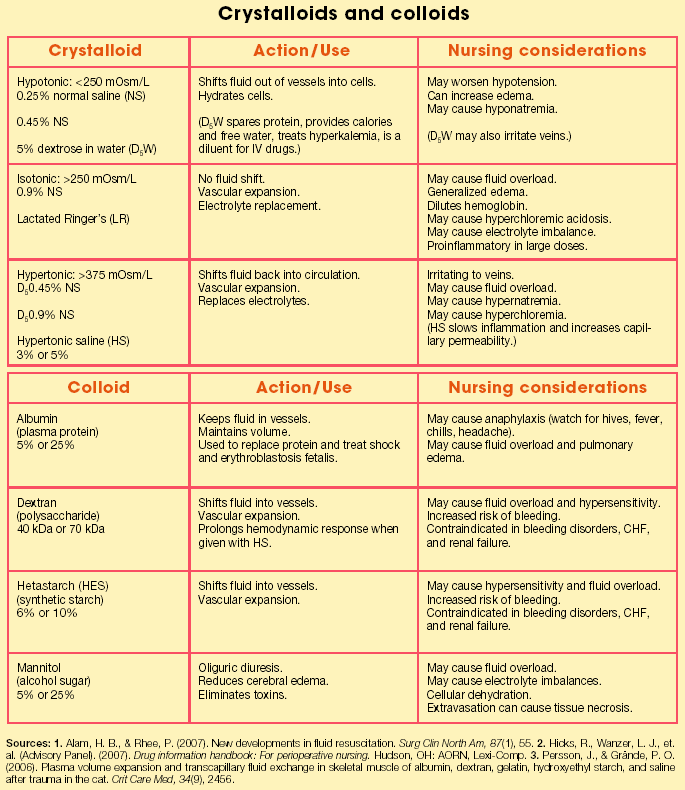
What's in IV Fluid Anyway?

It's 10 am... the most stressful time of the day for me during my internal medicine rotation... rounds. We round with 2 PAs and the attending. Rounds are the time when you give the team an oral report on your patients and all the relevant happenings since the last rounding session including med changes, reactions, vitals, Is and Os, eating and bowel habits, and the am physical exam findings - then you prioritize the problem list and come up with a plan. Sounds pretty straight forward until you throw a couple of patients with 13+ major diagnoses and over 25 medications each.

I must be a comical sight for the seasoned staff. I have about 25 note cards with chicken scratch from my morning routine, a notebook, and pockets full of pocket-sized manuals for the 2 patients that I am following. Meanwhile, they all walk around with a single piece of paper that contains all the notes for the 20 patients that they are each responsible for. Guess that's how the nurses spot a student from a mile away...

So anyway... the attending likes to frequently interrupt my oral reports with pimping questions, which only increases my stress level. One interesting question she asked was, "What are the electrolyte contents in normal saline, 1/2 NS, and D5W?" I hadn't the faintest idea. She informed me that she looked forward to me telling her the answer tomorrow. Hint, hint.

After rounds I visited the hospital pharmacy to ask if they had a list of all the IV fluids and their contents. My question elicited a laugh and a promise that they would "look around" for a list and page me when they found it. [That was 3 days ago. Still no page.] So I went home and hit up my pharmacy book. Nothing. CURRENT Medical. Nothing. Lange Critical Care Review. Nothing. Lange Surgery Review. Nothing. Fluids and Electrolytes Review. Nothing. Google, 4th page of results. Jackpot.

I didn't think it would be so difficult to find the content of IV fluids that we use on a daily basis! Almost all of the sources that I found explained how each solution was used - but I was just looking for a chart comparing the most-used IVFs... and then I found my golden ticket. I have listed the link to my handout below as well as some other resources I came across - hopefully they will come in handy for someone else.


Additional Resource:


http://studentnurselaura.wordpress.com/2010/02/13/iv-solutions/

10.05.2011

Lymphoma Outline (Printable)

One of the MDs that I have the privilege of working with is a Heme/Onc specialist. Once a week she blocks 30 min out of our schedule for "teaching time" - tomorrow we are working lymphomas. In preparation for our chat I have made a little outline (HL and NHL). Thought I would share: